
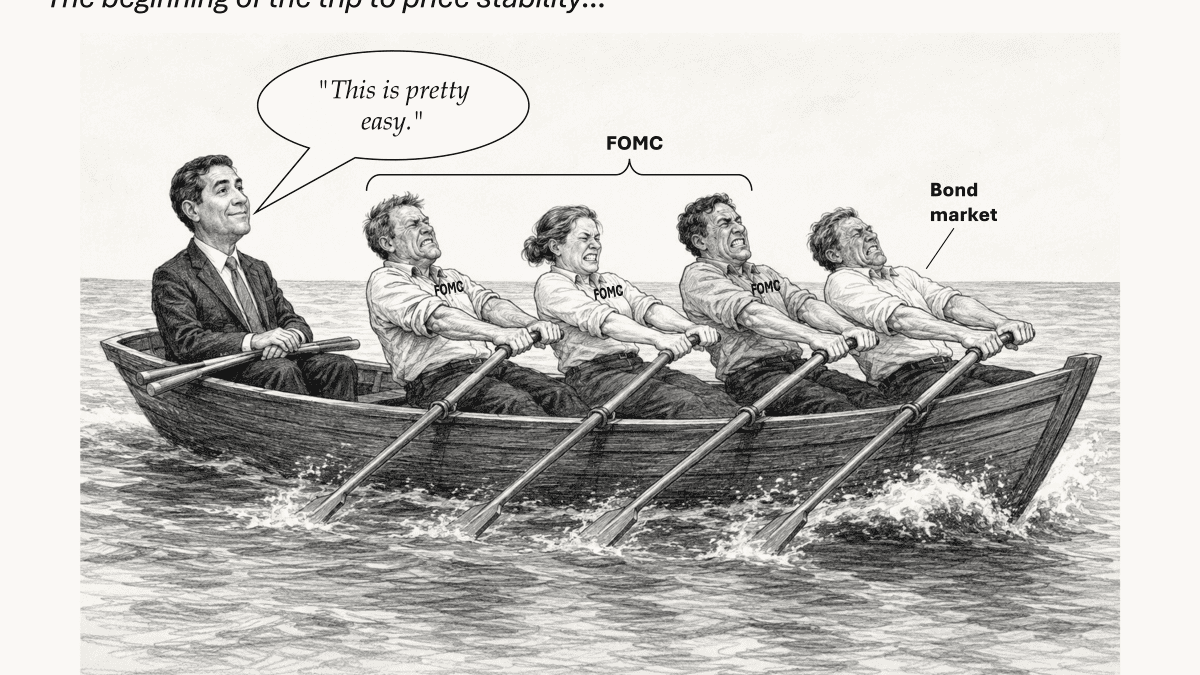
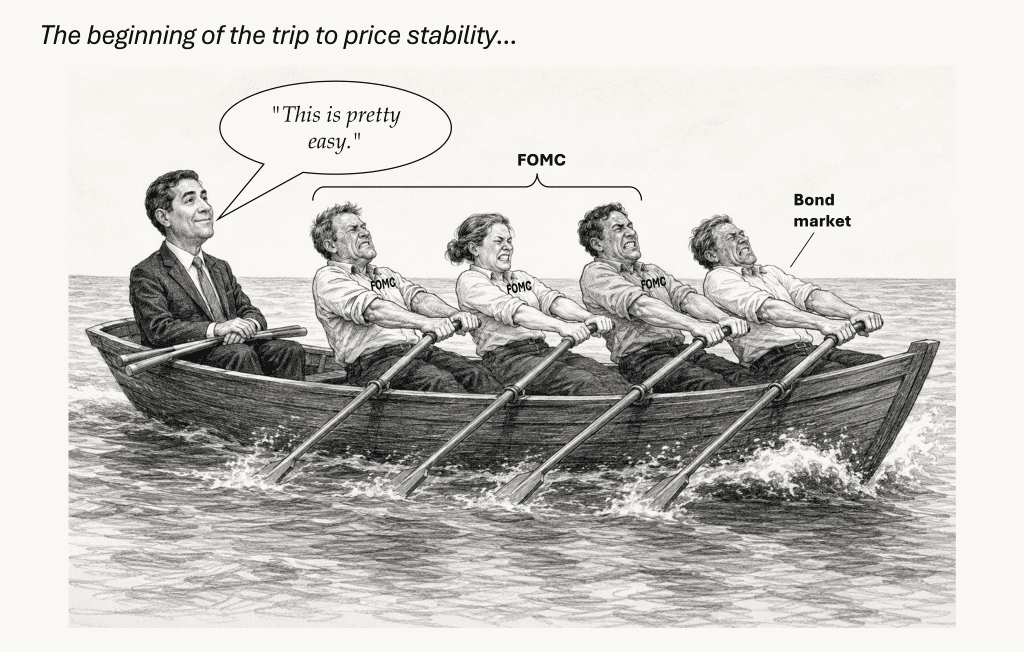
“The beginning of the story” – FOMC meeting review
Warsh was hawkish, the bond market didn’t quite get it, but the Fed is moving towards price stability with the reaction anyway.
I realized today that I haven’t written a longer public piece since the last FOMC meeting. The reason is that rates have done what I thought they would do, rise, and I’ve been putting more energy into “The Lantern Brief”, my daily for clients. Ask if you are interested in receiving it.
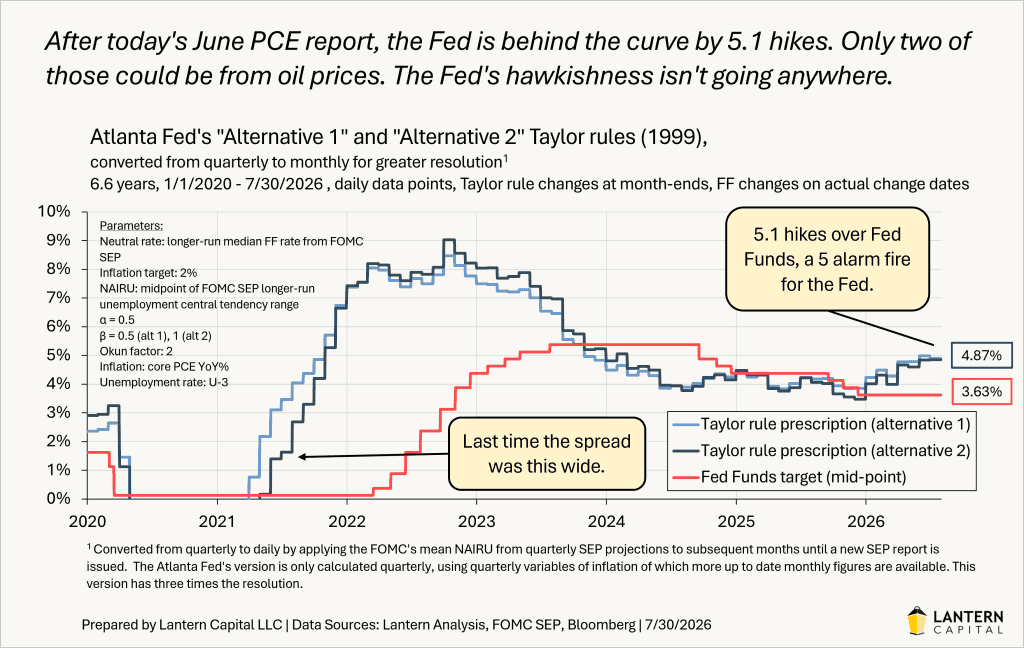
The Fed isn’t just a little too loose, they are a lot too loose. The reason Treasury yields are rising is that the Fed is 5 hikes! behind the curve by the Taylor rule (1999 version) and even more from the 1993 version. Many may not be looking at the Taylor rule explicitly, but most economists know that labor is at full employment and inflation is higher than target, which means raise rates. Not controversial, and Warsh said it yesterday. Many want to make the Fed’s hawkishness about the Iran war and oil’s rise, but core PCE YoY% was already 3.0% when the war began. Reversing what it has increased since then only accounts for about 2 of the 5 raises that the Fed is behind the curve. The reason I think inflation is high is that the economy is strong with an output surplus. I think the economy is strong because it is on the boom side of the cycle within the cycle, spurred by rates held low for six months (9/2025 – 2/2026) and the gigantic fiscal deficit underneath that. AI is a sideshow to the deficit. But all that said, the Fed’s hawkishness will go away when Treasury yields rise enough to slow the economy down again. I don’t think that will be more than a few months away.
Yesterday’s FOMC meeting corroborated this, and then some.
The Fed didn’t raise, but three presidents dissented in favor of a quarter point hike: Kashkari (Minneapolis), Logan (Dallas), and Hammack (Cleveland). That is the most dissents in the same direction since September 2016, pretty close to what I expected (I thought there would be two dissents with no raise), and it shows that more of the Fed is anxious to raise — not surprising once one sees the Taylor rule chart above which the Fed is very aware of.
Warsh’s press conference was even more hawkish than the previous one. In his opening statement, he stressed the Fed’s quest for price stability in more forceful terms than he used last time: “Let me reiterate: There is no soft inflation target, there is no soft implicit target, not on this Committee’s watch. There is only a target, and it is 2 percent.” Core PCE is 3.3%.
Steve Liesman of CNBC opened the questions by asking what message the Fed was getting from markets in the absence of forward guidance. Warsh used the answer to remind everyone the economy is solid: “As we said in the FOMC statement that you got at two o’clock, the economy output is solid. Capex and productivity are strong. Labor markets, solid, steady.”
Nick Timiraos of the Wall Street Journal asked which channel the Fed is relying on to bring inflation down, if not the labor market. Warsh said inflation is too high and that it is consuming the committee: “We’re doing pretty well, collectively, as a country, as policy makers on the full employment side. But we’re doing considerably less well on prices, that’s why we describe them as elevated, and that’s what’s taken most of our discussion.”
And Edward Lawrence of Fox Business asked what the argument for a “pause” was, why weren’t they raising today. Warsh rejected the premise, and then hinted the Fed is getting ready to raise: “If you were to try to force a description that this was a pause, I would say, financial market prices would take the other side of that. Financial market prices in this intermeeting period, they didn’t pause, they reacted to the inflation data in one direction, strong economic growth in the other direction. And nominal and real rates went up. Did the Fed take an explicit change in its policy rate today? No. But I think that’s the beginning of the story, not the end of the story.”
As an aside, I can’t find anyone in the media or X that has raised this “story” quote, just like nobody raised the “we’ve got some work to do on this price stability front” quote at the previous meeting. Commentary and news are often about what people want to happen, not what will happen, and nobody wants the Fed to raise.
Underneath all of it, Warsh explained that the Fed welcomes higher Treasury yields to do the work for them. That was the theme of the whole press conference: he was happy Treasury yields had risen intermeeting to tighten financial conditions without the Fed having to raise. In that same answer to Liesman, Warsh said, unprompted: “that’s why we’re seeing a tightening both in nominals and in reals, even while at some level, we haven’t done much in 42 days. The markets have done quite a bit.” And to Ann Saphir of Reuters, who pressed him on claiming no tolerance for inflation while taking no action: “If you look broadly at market prices, they are certainly not saying all clear, but they are working in concert to keep us on our toes, and they have tightened financial conditions in this intermeeting period, and that has provided us some comfort that we’ve got the ability and capability to deliver.” He is describing a substitute for his own action, approvingly.
He thinks the rise in Treasury yields is evidence of the market playing the ball (the economy) and not the referee (the Fed), which is his reasoning for why he wants to guide markets less. If this were sustainable, I would welcome it because Lantern predicts the Fed well, but I doubt it will last; it is going to cause problems. Former Cleveland Fed President Loretta Mester said the same yesterday, as quoted in the Wall Street Journal,
“I actually want more from my Fed. I want to feel comfortable that the Fed knows what it is doing,” she said. “I don’t think it’s sustainable, what he’s doing, in terms of not saying anything.”
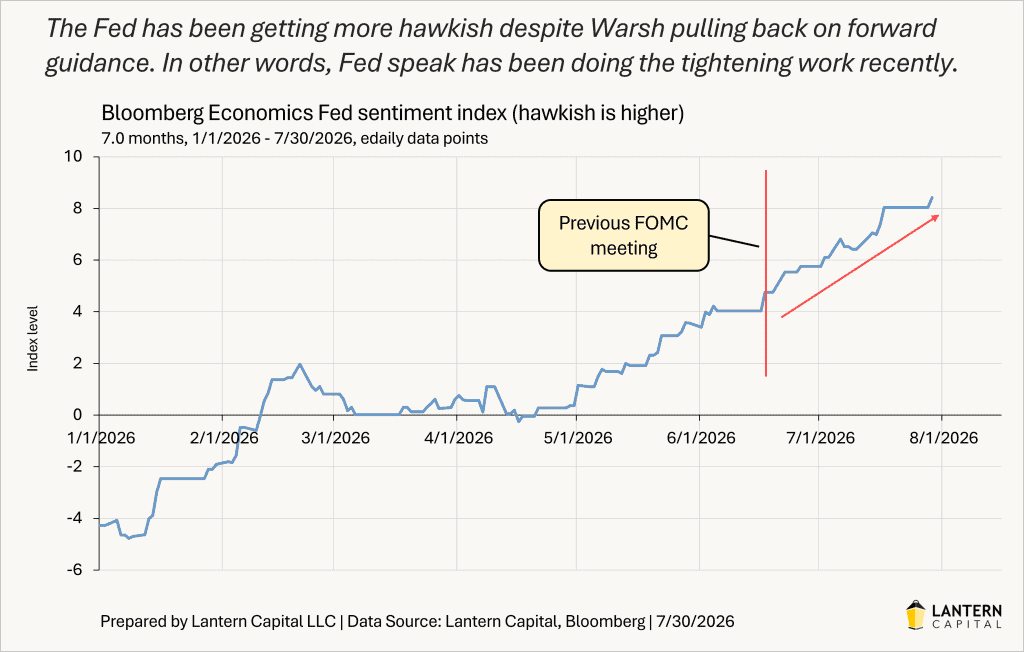
But back to now. Economic data was lower since the last meeting, by the LDEI and by the Citi surprise index, and Fed speak was more hawkish. Readers of my daily commentary know that FOMC members have been guiding to more hawkishness throughout the intermeeting period. Fed speak, the very forward guidance Warsh wants to avoid, moved Treasury yields higher since the previous meeting. Not economic data. The chart below shows Bloomberg’s Fed sentiment index rising materially since the previous meeting. Higher is more hawkish, and the red vertical line is the date of the previous meeting. The Fed has gotten more hawkish since it, and Warsh isn’t acknowledging it.
The yield curve has steepened enormously since the meeting. The market didn’t hear the hawkishness in the meeting, and so long-term yields are now making their own plea for the Fed to raise, since it wasn’t clear for the front-end. Inadvertently, from Warsh holding in overt hawkishness (which would’ve moved the 2-year higher), this steepening market reaction helps the Fed to slow the economy down faster than just pricing in raises. A basis point of higher yields at the long-end tightens financial conditions more than at the front-end because the greater duration affects bond values more.
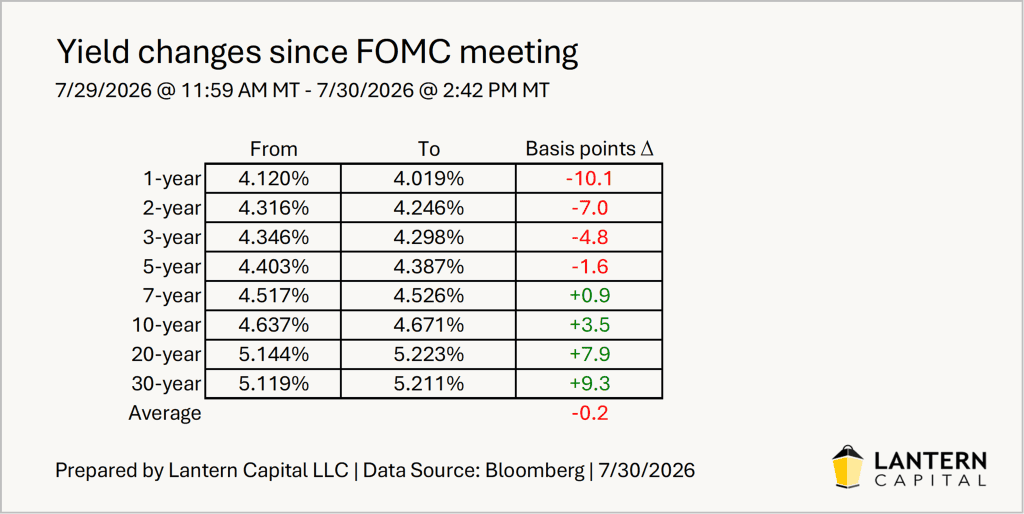
So how long does the story last then?
Just a few months. Treasury yields have already risen 79bps (average across the curve) in this secondary trend of higher rates and it seems to take 100 or so to turn the economy back over. Despite all the hawkishness, I bet the economy will break again before the Fed raises three times. Three raises would mean the economy holding up past December 9th and raising 25bps at each meeting from here. I don’t think this secondary trend of higher rates will last that long before the economy turns back lower and the Fed’s hawkishness melts with it. In other words, the Fed’s threat of hiking should do the trick to turn the economy around again without much actual raising. I still expect the 2-year to price in around 3.5 raises before the economy breaks again, so I have a target on the 2-year of 4.60-4.70%, roughly two-thirds of the Taylor gap, though yields may retreat for a bit before they rise again.
So, I expect Fed voices to turn up the temperature with hawkish speeches now. Look for an FOMC member to mention the Taylor rule (Waller did it back in November 2023), or to mention that the economy needs a “few raises,” or to re-iterate “beginning of the story.” I contend that the Fed doesn’t want to have to raise rates. They would much rather threaten them and slow the economy down before they have to raise and make it permanent. And it is very doable, ironically, with the forward guidance Warsh just abandoned. I think most of the Fed knows the economy is in the middle of the downside of the business cycle, the primary trend lower in short-term rates, and they don’t want to raise just to turn around and have to lower six months later. Payrolls have only just gotten near zero and have ratcheted further down in each secondary trend, the yield curve indicates the cycle being about a third of the way through, and John Williams (New York) said in May that rates will need to be lower at some point. The Fed has a great streak of being unidirectional during business cycles, which is part of the Fed’s credibility. The Fed doesn’t really want to hike, they just want you to believe they will. That’s a reasonable tactic now, not a dodge. But all roads lead to price stability, regardless of how it gets done: economy break, forward guidance, or actual raising.